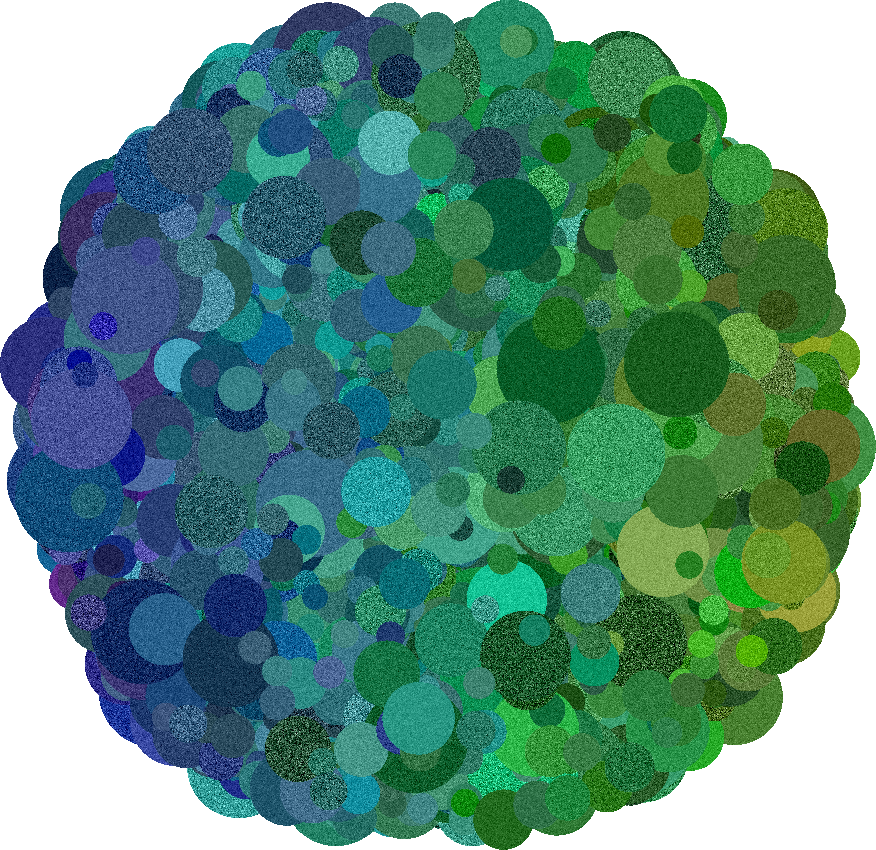
deadleaves#
Submodules#
Classes#
Set up the geometrical dead leaves model. |
|
Setup color and texture model for a dead leaves partition. |
|
Setup leaf geometry and appearance for rendering. |
|
Topology-level operations on leaf tables to |
Package Contents#
- class deadleaves.LeafGeometryGenerator(leaf_shape: Literal['circular', 'ellipsoid', 'rectangular', 'polygon'], shape_param_distributions: dict[str, dict[str, dict[str, float | dict]]], image_shape: tuple[int, int], position_mask: torch.Tensor | numpy.ndarray | dict | None = None, n_sample: int | None = None, device: Literal['cuda', 'mps', 'cpu'] | None = None)#
Set up the geometrical dead leaves model.
- Args:
- leaf_shape (Literal[“circular”, “ellipsoid”, “rectangular”, “polygon”]):
Shape of leaves.
- shape_param_distributions (dict[str, dict[str, [dict[str, float | dict]]]):
Leaf shape parameters and their distributions and hyperparameter values.
- image_shape (tuple[int, int]):
Height (y, M) and width (x, N) of the canvas.
- position_mask (torch.Tensor | np.ndarray | dict | None, optional):
Boolean tensor containing allowed leaf positions to create images with different shapes. If None all positions on the canvas are allowed. Defaults to None.
- n_sample (int | None, optional):
Number of leaves to sample. If None, the sampling will stop when the full area is partitioned. Default is None.
- device (Literal[“cuda”, “mps”, “cpu”] | None, optional):
Torch device to use, either ‘cuda’ or ‘cpu’. If None, device will be chosen automatically. Defaults to None.
- device: torch.device#
Chosen compute backend.
- image_shape: tuple[int, int]#
Height (y, M) and width (x, N) of the canvas.
- n_sample: int | None = None#
Number of leaves to sample.
- leaf_shape: Literal['circular'] | Literal['ellipsoid'] | Literal['rectangular'] | Literal['polygon']#
Shape of the leaves.
- shape_param_distributions#
Shape parameters and their distributions and hyperparameter values.
- generate_leaf_mask: Callable#
Method to generate mask of leaf on canvas.
- position_mask: torch.Tensor#
Positions on canvas masked for sampling leaf positions.
- _resolve_dependencies() list[str]#
Resolve model parameter dependencies.
- Raises:
- ValueError:
Error on circular or unresolvable dependencies.
- Returns:
- list[str]:
Sorted list of parameters.
- _unpack_parameters() None#
Generate list of model parameters and distribution instances to sample from.
- Raises:
- ValueError:
Provided parameters don’t match provided leaf shape.
- _sample_parameters() dict[str, torch.Tensor]#
Draw a sample from the model distributions.
- Returns:
- dict[str, torch.Tensor]:
Sample for each model parameter.
- _resolve_position_mask(position_mask: torch.Tensor | numpy.ndarray | dict) None#
Resolve position mask from tensor or geometric specification.
- Args:
- position_mask (torch.Tensor | np.ndarray | dict):
Boolean tensor or array with allowed sampling positions or dictionary specifying a leaf shape and its parameters.
- Raises:
- ValueError:
Position mask dict must contain ‘shape’ and ‘params’.
- ValueError:
Check for unsupported leaf shapes in dict.
- TypeError:
Check argument type.
- ValueError:
Check that position mask has same size as canvas.
- ValueError:
Check that there are allowed positions.
- generate_segmentation() tuple[pandas.DataFrame, torch.Tensor]#
Generate a dead leaves segmentation from the model.
Uses a quadtree to track which canvas regions still contain uncovered pixels. Fully covered subtrees are pruned from future queries, so mask evaluation is restricted to the sparse frontier of remaining gaps.
- Returns:
- tuple[pd.DataFrame, torch.Tensor]:
Dataframe listing the parameters of all generated leaves, along with an segmentation map assigning each image location to a leaf.
- class deadleaves.LeafAppearanceSampler(leaf_table: pandas.DataFrame, device: Literal['cuda', 'mps', 'cpu'] | None = None)#
Setup color and texture model for a dead leaves partition.
- Args:
- leaf_table (pd.DataFrame):
Dataframe of leaves and their parameters.
- device (Literal[“cuda”, “mps”, “cpu”] | None, optional):
Torch device to use, either ‘cuda’ or ‘cpu’. If None, device will be chosen automatically. Defaults to None.
- device: torch.device#
Chosen compute backend.
- leaf_table: pandas.DataFrame#
Dataframe of leaves and their parameters.
- n_leaves: int#
Number of leaves.
- _unpack_color() None#
Generate color distribution instances to sample from.
- _sample_grayscale_colors() torch.Tensor#
Sample a grayscale color for each leaf.
- Returns:
- torch.Tensor:
Color values.
- _sample_3d_colors() torch.Tensor#
Sample a 3d color for each leaf.
- Returns:
- torch.Tensor:
Color values.
- _sample_colors_from_images() torch.Tensor#
Sample a pixel value for each leaf from a random image in folder.
- Returns:
- torch.Tensor:
Color values.
- sample_color(color_param_distributions: dict[str, dict[str, dict[str, float]]] | dict[str, dict[str, dict[str, dict]]] | dict[str, dict[str, dict[str, str]]]) pandas.DataFrame#
Sample leaf colors according to the configured color space.
- Args:
- color_param_distributions (dict[str, dict[str, dict[str, float | dict | str]]]):
Color parameters and their distribution setup.
- Returns:
- pd.DataFrame:
Updated DataFrame with color parameters added to each leaf
- _unpack_texture() None#
Generate texture distribution instances to sample from.
- _sample_texture_parameters() pandas.DataFrame#
Materialize per-leaf texture parameters and distribution metadata.
- Returns:
- pd.DataFrame
One row per leaf with resolved texture parameters for all channels.
- sample_texture(texture_param_distributions: dict[str, dict[str, dict[str, float | str | dict[str, dict[str, float]]]]]) pandas.DataFrame#
Sample leaf textures according to the configured color space.
- Args:
- texture_param_distribution (dict[str, dict[str, dict[str, float | dict[str, dict[str, float]]]]]):
Texture parameters and their distribution setup.
- Raises:
- ValueError:
Chosen texture space is not supported.
- Return:
- pd.DataFrame:
Updated DataFrame with texture parameters added to each leaf
- class deadleaves.ImageRenderer(leaf_table: pandas.DataFrame, segmentation_map: torch.Tensor | None = None, image_shape: tuple[int, int] | None = None, background_color: torch.Tensor | None = None, device: Literal['cuda', 'mps', 'cpu'] | None = None)#
Setup leaf geometry and appearance for rendering.
- Args:
- leaf_table (pd.DataFrame):
Dataframe of leaves and their parameters.
- segmentation_map (torch.Tensor | None, optional):
Partition which assigns image locations to a leaf. If None the segmentation map will be generated from the leaf table. Defaults to None.
- image_shape (tuple[int,int] | None, optional):
Height (y, M) and width (x, N) of the canvas. If None the image_shape will be set based on the segmentation map. Defaults to None. Either image_shape or segmentation_map need to be given.
- background_color (torch.Tensor | None, optional):
For images which are not fully covered (due to a position mask or sparse sampling) one can set a RGB background color. If None the background will be black. Defaults to None.
- device (Literal[“cuda”, “mps”, “cpu”] | None, optional):
Torch device to use, either ‘cuda’ or ‘cpu’. If None, device will be chosen automatically. Defaults to None.
- device: torch.device#
Chosen compute backend.
- background_color: torch.Tensor | None = None#
Color for pixels not belonging to any leaf.
- leaf_table: pandas.DataFrame#
Dataframe of leaves and their parameters.
- segmentation_map: torch.Tensor | None = None#
Partition of the image area.
- image_shape: tuple[int, int]#
Height (y, M) and width (x, N) of the canvas.
- _resolve_image_shape(image_shape: tuple[int, int] | None, segmentation_map: torch.Tensor | None) tuple[int, int]#
Resolve image shape from segmentation_map or explicit image_shape.
- Raises:
- ValueError:
Shape of segmentation map and provided image shape don’t match.
- ValueError:
Neither image_shape nor segmentation map are given.
- _generate_segmentation_map() None#
Generate segmentation map if None is provided.
- _infer_texture_space() None#
Infer which color space the texture parameters are defined in.
- _infer_color_space() None#
Infer which color space the color parameters are defined in.
- _get_texture_param_columns(channel: str) list[str]#
Get all columns which contain texture parameters from leaf_table.
- Args:
- channel (str):
Color channel to extract parameters for.
- Returns:
- list[str]:
Columns with parameters for channel texture.
- _get_leaf_texture_params(leaf_row: pandas.Series, channel: str) dict#
Get values from columns with texture parameters in leaf_table.
- Args:
- leaf_row (pd.Series):
Single row from leaf table.
- channel (str):
Channel name.
- Returns:
- dict:
Parameters for leaf texture as dictionary.
- _generate_leafwise_texture_1d(channel: str) torch.Tensor#
Generate grayscale texture from sampled distributions.
- Args:
- channel (str):
Color channel name.
- Returns:
- torch.Tensor
Texture image of shape (H, W).
- _generate_leafwise_texture_from_source() torch.Tensor#
Generate grayscale texture from image sources stored in leaf_table.
- Returns:
- torch.Tensor
Texture image of shape (H, W).
- _generate_leafwise_texture() torch.Tensor#
Generate a per-pixel texture image from leafwise texture parameters.
- Raises:
- ValueError:
Fallback for unknown specifications.
- Returns:
- torch.Tensor
Texture RBG image of shape (H, W, 3).
- render_image() torch.Tensor#
Generate a dead leaves image.
- Returns:
- torch.Tensor:
Dead leaves image tensor.
- apply_image_noise(noise: dict[str, dict | torch.Tensor], image: torch.Tensor | None = None) torch.Tensor#
Apply global noise to an image.
- Args:
- image (torch.Tensor):
Input image tensor of shape (H, W, C), values in [0,1].
- noise (dict):
Dictionary or tensor/array specifying noise per channel. Examples: - Distribution-based: {“gray”: {“normal”: {“loc”: 0, “scale”: 0.1}}} - Array-based: {“R”: torch.randn(H, W) * 0.05}
- Returns:
- torch.Tensor:
Image with noise applied, clipped to [0,1].
- show(image: torch.Tensor | None = None, figsize: tuple[int, int] | None = None) None#
Show selected image.
- Args:
- image (torch.Tensor, optional):
Image to show. If None the self.image will be used.
- figsize (tuple[int,int], optional):
Figure size in inches (width, height). If None size is inferred from image size. Defaults to None.
- save(save_to: pathlib.Path | str, image: torch.Tensor | None = None) None#
Save image to path.
- Args:
- save_to (Path):
Path to file to save image to.
- image (torch.Tensor, optional):
Image to save. If None the self.image will be used.
- animate(fps: int = 10, save_to: pathlib.Path | None = None) matplotlib.animation.FuncAnimation#
Generate animation of dead leaves partition generation.
- Args:
- fps (int, optional):
Frames per second of animation. In each frame a new leaf is sampled. Defaults to 10.
- save_to (Path, optional):
Path to file to save animation to. If None the animation will not be saved. Defaults to None.
- Returns:
- animation.FuncAnimation:
Animation of partition generation.
- class deadleaves.LeafTopology(image_shape: tuple[int, int] | None = None, device: Literal['cuda', 'mps', 'cpu'] | None = None)#
Topology-level operations on leaf tables to - Construct segmentation maps - Merge and relabel leaf tables - Manage leaf identities (leaf_idx)
- Args:
- image_shape (tuple[int, int] | None, optional):
Height (y, M) and width (x, N) of the area to be partitioned.
- device (Literal[“cuda”, “mps”, “cpu”] | None, optional):
Torch device to use, either ‘cuda’ or ‘cpu’. If None, device will be chosen automatically. Defaults to None.
- image_shape: tuple[int, int] | None = None#
Height (y, M) and width (x, N) of the canvas.
- device: torch.device#
Chosen compute backend.
- static _validate_geometry(leaf_table: pandas.DataFrame) None#
Check if leaf table contains parameters necessary for constructing the geometry.
- Args:
- leaf_table (pd.DataFrame):
Dataframe of leaves and their parameters.
- Raises:
- ValueError:
If required columns are missing, unknown shapes are present, or required parameters contain NaNs.
- _cull_outside_canvas(leaf_table: pandas.DataFrame) pandas.DataFrame#
Remove leaves whose centers are outside the canvas.
- Args:
- leaf_table (pd.DataFrame):
Dataframe of leaves and their parameters.
- Returns:
- pd.DataFrame:
Reduced table.
- segmentation_map_from_table(leaf_table: pandas.DataFrame) torch.Tensor#
Construct a segmentation map from a leaf table.
- Args:
- leaf_table (pd.DataFrame):
Dataframe of leaves and their parameters.
- Returns:
- torch.Tensor:
Segmentation map which assigns each image location to a leaf.
- static merge_leaf_tables(*leaf_tables: pandas.DataFrame) pandas.DataFrame#
Merge multiple leaf tables and assign fresh leaf_idx.
- Args:
- leaf_tables (pd.DataFrame):
List of tables to be merged.
- Returns:
- pd.DataFrame:
Merged table.
- static reindex_by_group(leaf_table: pandas.DataFrame, groupby: str, shuffle: bool = True, group_order: str | None = None, seed: int | None = None) pandas.DataFrame#
Reassign leaf_idx within groups.
- Args:
- leaf_table (pd.DataFrame):
Dataframe of leaves and their parameters.
- groupby (str):
Column containing the groups.
- shuffle (bool):
If true shuffle leaf index within group. Defaults to true.
- group_order (str | None):
Order of groups: “ascending”, or “descending”, or random (None). Defaults to None.
- seed (int | None):
Set value for generating a random seed for reproducibility. If None a different random seed will be set at each execution. Defaults to None.
- Returns:
- pd.DataFrame:
Reindexed (and shuffled) table.
- static randomize_index(leaf_table: pandas.DataFrame, seed: int | None = None) pandas.DataFrame#
Randomly reassign a global index while preserving all row attributes.
This shuffles depth ordering across all leaves, including across semantic groups (e.g. target vs background), while keeping group labels intact.
- Args:
- table (pd.DataFrame):
Input leaf table.
- seed (int, optional):
Random seed for reproducibility. Default to None.
- Returns:
- pd.DataFrame:
Table with randomized index_col.